Words that will be used during the first unit of the heat transfer module
Convection heat transfer coefficient
Noun
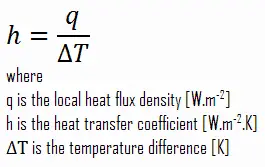
The convection heat transfer coefficient, h, can be defined as: The rate of heat transfer between a solid surface and a fluid per unit area per unit temperature difference
Example: The convection heat transfer coefficient depends on the physical properties of the fluid and the physical situation.
es: Coeficiente de transferencia de calor por convección
Critical Reynold’s number
Noun
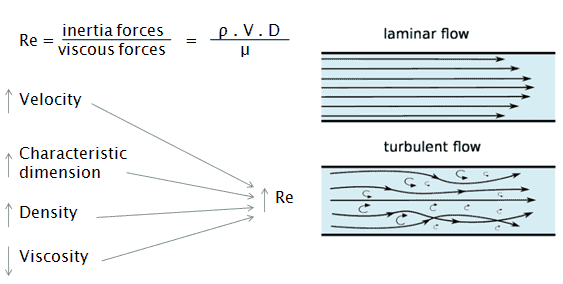
The Reynolds number is the ratio of inertial forces to viscous forces and is a convenient parameter to predict whether a flow condition will be laminar or turbulent.
Example: The critical Reynolds number is associated with the laminar-turbulent transition, in which a laminar flow becomes turbulent.
es: Número crítico de Reynold
Friction Coefficient
Noun
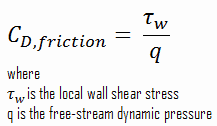
The average friction and heat transfer coefficients are determined by integrating Cf,x and Nux over the surface of the given body with respect to x* from 0 to 1.
Example: The friction coefficient for a given geometry can be expressed in terms of the Reynolds number Re and the dimensionless space variable x.
es: Coeficiente de fricción
Kinematic viscosity
Noun
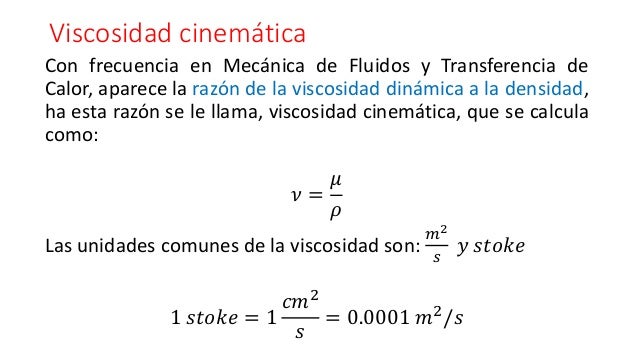
The kinematic viscosity σ is the quotient between the dynamic viscosity and density.
es: Viscosidad cinemática
Laminar flow
Noun
It is called laminar flows, the movement of a fluid when it is ordered, stratified and smooth
Example: In laminar flow the fluid moves in parallel sheets without intermingling and each fluid particle follows a path called the streamline.
es: Flujo laminar
Nusselt number
Noun
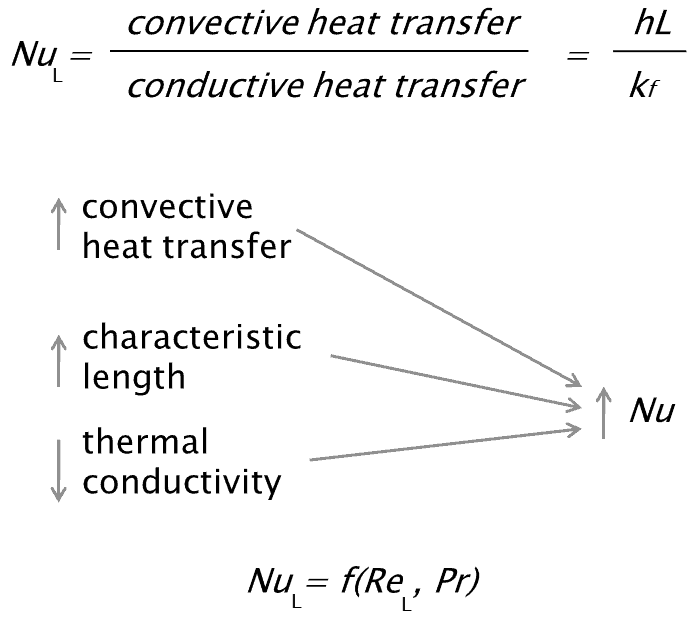
The Nusselt number (Nu) is a dimensionless number that measures the increase in heat transfer from a surface through which a fluid flows.
Example: The Nusselt number is defined as convective heat transfer over conductive heat transfer
es: Número de Nusselt
Prandtl number
Noun
The Prandtl number (Pr) is a dimensionless number proportional to the quotient between the diffusion rate of the amount of moment (viscosity) and the thermal diffusivity.
Example: The Prandtl number (Pr) is defined as the molecular diffusivity of the impulse over the molecular diffusivity of the heat.
es: Número de prandtl
Reynold number
Noun
The Reynolds number (Re) is a dimensionless number used in fluid mechanics, reactor design, and transport phenomena to characterize the motion of a fluid. Its value indicates whether the flow follows a laminar or turbulent pattern.
Example: The Reynolds number (Re) is defined as the inertial forces over the viscous forces.
es: Número de Reynold
Shear stress
Noun
Consider the flow of a fluid over the surface of a plate. The fluid layer in contact with the surface will try to drag the plate by the effect of the friction, by exerting a frictional force on it.
Example: The friction force per unit area is called the shear stress.
es: Esfuerzo cortante
Turbulent flow
Noun
Turbulent flow is characterized by the irregular movement of particles (we can say chaotic) of the fluid.
Example: In turbulent flow, the velocity of the fluid at a point is undergoing continuous changes in both magnitude and direction.